
Description
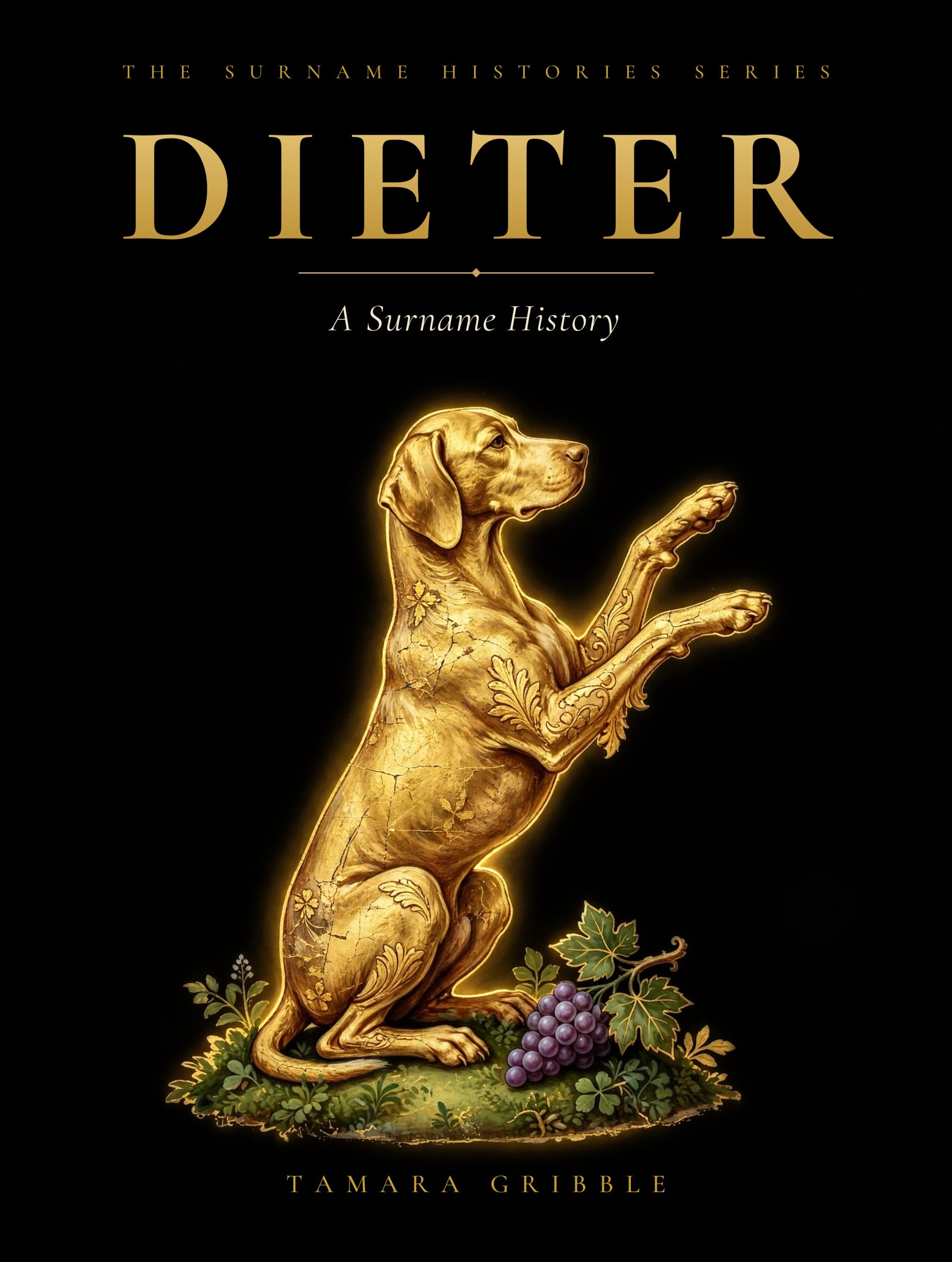
Dieter: A Surname History — Volume 125 of The Surname Histories Series.
Dieter descends from Theudhar — theud, “the people,” and hari, “the army” — a Germanic name of the migration age that the Dictionary of American Family Names keeps carefully apart from Dietrich, the famous name it is most often confused with. It is a small name: 3,298 Americans bore it in the 2010 Census, rank 9,818 — and a strange one, for in America the name largely ceased to be itself. Carried into the Virginia backcountry in 1727, it softened within a generation into Teter and Teeter, and those two spellings now outnumber Dieter itself; the parent name survives as the rarer form of its own line.
Its documented American founding is a mayor’s son: Hans Jörg Dieter of Schwaigern, in the Kraichgau wine country, who inventoried his black coat and leather trousers before the town’s police court, crossed on the Molly, signed the oath at Philadelphia on 30 September 1727, patented two hundred acres on the Robinson River in 1736, and died intestate in Orange County in 1744 — his estate appraised at £32 10s, with cattle, a wagon, three guns and, among the household goods, some books. His widow’s line rode the Great Wagon Road to North Carolina and the West Virginia valleys as Teters; a second, unproven stratum surfaces at Tulpehocken; and a century and a half later a German settler named Martin Van Buren Dieter voted in Roseau County’s first election, in 1888, and left the name on the Minnesota map, where Dieter Township carries it still.
The record is printed searched whole: both of Paul Heinegg’s volumes read for the name and its forms, their bounded negative stated with its scope; the founder’s appraisement, which names no enslaved person; and the one human being the slavery archive does hold under this name — a boy of about six, recorded by the single name Dieter in a North Carolina divorce petition of 1856 — printed entire. The heraldry chapter settles a family war: in 1971 a mail-order shield put goats where the record has dogs, and this book prints Rietstap’s own blazon, verified in the Armorial Général itself, beside the correction letter that defended it. The spotlight falls on George E. Dieter Jr. of Philadelphia — metallurgist, author of Mechanical Metallurgy, dean of engineering at Drexel and at Maryland, and member of the National Academy of Engineering — the most widely read bearer a name of 3,298 people has produced.
If you’ve ever wondered where your last name comes from, this is where its story lives.



Reviews
There are no reviews yet.